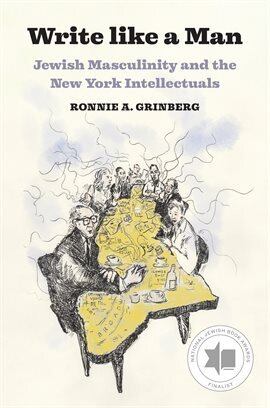
How virility and Jewishness became hallmarks of postwar New York's combative intellectual scene
In the years following World War II, the New York intellectuals became some of the most renowned critics and writers in the country. Although mostly male and Jewish, this prominent group also included women and non-Jews. Yet all of its members embraced a secular Jewish machismo that became a defining characteristic of the contemporary experience. Write like a Man examines how the New York intellectuals shared a uniquely American conception of Jewish masculinity that prized verbal confrontation, polemical aggression, and an unflinching style of argumentation.
Ronnie Grinberg paints illuminating portraits of figures such as Norman Mailer, Hannah Arendt, Lionel and Diana Trilling, Mary McCarthy, Norman Podhoretz, Midge Decter, and Irving Howe. She describes how their construction of Jewish masculinity helped to propel the American Jew from outsider to insider even as they clashed over its meaning in a deeply anxious project of self-definition. Along the way, Grinberg sheds light on their fraught encounters with the most contentious issues and ideas of the day, from student radicalism and the civil rights movement to feminism, Freudianism, and neoconservatism.
A spellbinding chronicle of mid-century America, Write like a Man shows how a combative and intellectually grounded vision of Jewish manhood contributed to the masculinization of intellectual life and shaped some of the most important political and cultural debates of the postwar era. Ronnie A. Grinberg is associate professor of history and a core faculty member of the Schusterman Center for Judaic and Israel Studies at the University of Oklahoma. "Ronnie Grinberg has accomplished something remarkable in this book: she has produced a history of the work and lives of the New York intellectuals that is original, incisive, empathetic, critical-and a joy to read. No one has understood the lives and work of the women and men in that beloved, notorious cohort so well."-Michael Kazin, author of What It Took to Win: A History of the Democratic Party
"With flowing prose, historical acuity, and human sensitivity, Grinberg draws our attention to something so obvious about the New York intellectuals that it has been largely unexamined until now: their masculinity. The women who orbited the group-as wives, lovers, and sometimes begrudgingly accepted members-illustrate most powerfully how the Cold War pressures of Jewish masculinity delimited the world of ideas. No matter how iconoclastic these mid-century thinkers tried to be, they were stuck in the stultifying straits of their gender anxiety."-Lila Corwin Berman, author of The American Jewish Philanthropic Complex
"Ronnie Grinberg's fantastic book shows us how the post–World War II New York intellectuals drew on the combative Talmudic tradition and their desire to overcome historic stereotypes of Jews as sissies to craft a pugilistic style of writing, thinking, and being that came to be their calling card and definition of masculinity. Write like a Man provides a remarkable look at these figures, revealing much about their time, and ours."-Kevin M. Schultz, University of Illinois Chicago "Longlisted for the National Book Critics Circle Awards, Criticism Category" "Finalist for the National Jewish Book Award in American Jewish Studies, Jewish Book Council" "Finalist for the National Jewish Book Award in Women's Studies, Jewish Book Council" "Grinberg's book is filled with such lively anecdotes, attentive to both the energy and absurdity generated by a coterie of brilliant eggheads who identified as fearless brawlers."---Jennifer Szalai, New York Times "There have been many other notable and worthy books about the influential New York Jewish intellectuals. . . . But none have been as attentive as Grinberg to how their experiences as Jews shaped their understandings of masculinity, or of how t