  • Hoopla logo
  • Browse
  • My Hoopla
  • Log In
Books, videos, and music - all free from your public library!
LoginSign Up

Footer

Hoopla logo, Go to homepage
  • For Patrons
  • For Libraries (opens in new window)
  • For Vendors (opens in new window)
  • Facebook (opens in new window)
  • X (opens in new window)
  • Instagram (opens in new window)
  • YouTube (opens in new window)
  • TikTok (opens in new window)
  • LinkedIn (opens in new window)

Our Company

  • Our Story
  • Get Hoopla for your Library (opens in new window)
  • Get your content on hoopla (opens in new window)
  • Join our team (opens in new window)
  • Accessibility Statement

Our Content

  • Audiobooks
  • Ebooks
  • Movies
  • Television
  • Comics
  • BingePasses
  • Music
  • The Loop Blog

Help

  • Help Center
  • Submit Feedback
  • Facebook (opens in new window)
  • X (opens in new window)
  • Instagram (opens in new window)
  • YouTube (opens in new window)
  • TikTok (opens in new window)
  • LinkedIn (opens in new window)
  • Download on the App Store (opens in new window)
  • Get it on Google Play (opens in new window)
  • Available at Amazon Appstore (opens in new window)
© 2026 Midwest Tape, LLC. All rights reserved. Privacy Policy | Terms of Use
  1. Navigate Home
  2. Ebooks
  3. Unlikely Allies

EBOOK

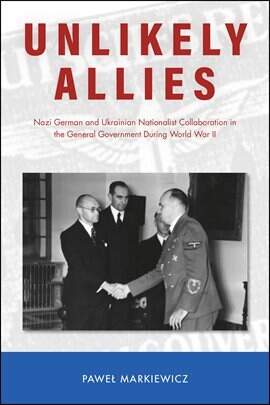
Unlikely Allies

Nazi German and Ukrainian Nationalist Collaboration in the General Government During World War II

Pawel MarkiewiczSeries: Central European Studies
(0)
sign up
Pages
320
Year
2021
Language
English
Publisher
Purdue University Press

About

Unlikely Allies offers the first comprehensive and scholarly English-language analysis of German-Ukrainian collaboration in the General Government, an area of occupied Poland during World War II. Drawing on extensive archival material, the Ukrainian position is examined chiefly through the perspective of Ukrainian Central Committee head Volodymyr Kubiiovych, a prewar academic and ardent nationalist. The contact between Kubiiovych and Nazi administrators at various levels shows where their collaboration coincided and where it differed, providing a full understanding of the Ukrainian Committee's ties with the occupation authorities and its relationship with other groups, like Poles and Jews, in occupied Poland.

Ukrainian nationalists' collaboration created an opportunity to neutralize prewar Polish influences in various strata of social life. Kubiiovych hoped for the emergence of an autonomous Ukrainian region within the borders of the General Government or an ethnographic state closely associated with the Third Reich. This led to his partnership with the Third Reich to create a new European order after the war. Through their occupational policy of divide to conquer, German concessions raised Ukrainians to the position of a full-fledged ethnic group, giving them the respect they sought throughout the interwar period. Yet collaboration also contributed to the eruption of a bloody Polish-Ukrainian ethnic conflict. Kubiiovych's wartime experiences with Nazi politicians and administrators-greatly overlooked and only partially referenced today-not only illustrate the history of German-Ukrainian and Polish-Ukrainian relations, but also supply a missing piece to the larger, more controversial puzzle of collaboration during World War II.
Related Subjects

  • Poland
  • Europe
  • History
  • Adult Nonfiction
  • Nationalism & Patriotism
  • Political Ideologies
  • Political Science
  • General
  • World War II
  • Wars & Conflicts

Extended Details

  • SeriesCentral European Studies

    Artists

    Pawel MarkiewiczAuthor