Books, videos, and music - all free from your public library!
LoginSign Up

Footer

Hoopla logo, Go to homepage
  • For Patrons
  • For Libraries (opens in new window)
  • For Vendors (opens in new window)
  • Facebook (opens in new window)
  • X (opens in new window)
  • Instagram (opens in new window)
  • YouTube (opens in new window)
  • TikTok (opens in new window)
  • LinkedIn (opens in new window)

Our Company

  • Our Story
  • Get Hoopla for your Library (opens in new window)
  • Get your content on hoopla (opens in new window)
  • Join our team (opens in new window)
  • Accessibility Statement

Our Content

  • Audiobooks
  • Ebooks
  • Movies
  • Television
  • Comics
  • BingePasses
  • Music
  • The Loop Blog

Help

  • Help Center
  • Submit Feedback
  • Facebook (opens in new window)
  • X (opens in new window)
  • Instagram (opens in new window)
  • YouTube (opens in new window)
  • TikTok (opens in new window)
  • LinkedIn (opens in new window)
  • Download on the App Store (opens in new window)
  • Get it on Google Play (opens in new window)
  • Available at Amazon Appstore (opens in new window)
© 2026 Midwest Tape, LLC. All rights reserved. Privacy Policy | Terms of Use
  • Hoopla logo
  • Browse
  • My Hoopla
  • Log In
  1. Navigate Home
  2. Ebooks
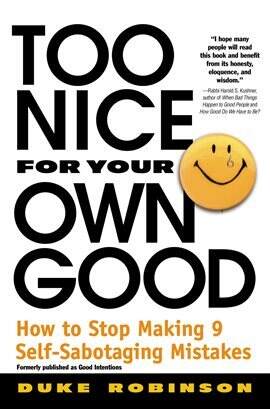
  3. Too Nice for Your Own Good

EBOOK

Too Nice for Your Own Good

How to Stop Making 9 Self-Sabotaging Mistakes

Duke Robinson
(0)
sign up
Pages
288
Year
2000
Language
English
Publisher
Grand Central Publishing

About

With the poignant honesty of Robert Fulghum and the good sense of "Dear Abby", this practical guide shows effective ways to avoid being "too" nice and reclaim a satisfying and fulfilling life.

Most people are raised to be "nice". But some just overdo it. They want to be perfect: always helpful, always available, never distinguishing between their own needs and those of others. Inside they're frustrated and unhappy. By analyzing the nine most common pitfalls, "Good Intentions" shows how the afflicted can liberate themselves from this damaging behavior, assert their own needs, and still remain the "good person" they've always wanted to be.
Related Subjects

  • Personality
  • Psychology
  • Adult Nonfiction

Artists

Duke RobinsonAuthor