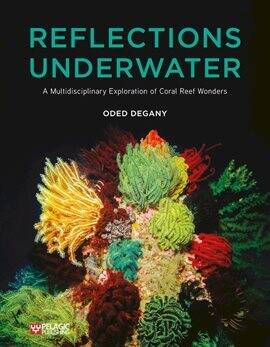
Why are we as humans so attracted to water and to colorful reefs? Indeed, why are reefs so dazzling? How did cleaning station symbiosis evolve? How come there are so many extraordinary defense mechanisms among reef animals? Do the denizens of reefs have consciousness? How did warning coloration evolve? In what ways do fundamental mathematical rules manifest in coral reefs? For answers to these questions and many more, take a dive into Reflections Underwater.
Coral reefs are one of the world's great natural wonders: endlessly surprising and mesmerizing kaleidoscopic fractals of color and life. But they are also under serious threat from the effects of climate change and development. Reflections Underwater is a unique, illuminating book that explores a stunning variety of topics and concepts relating to coral reefs.
Adopting a holistic, multidisciplinary perspective that weaves together scientific and humanistic ideas, including psychology, evolution, zoology, philosophy, mathematics, art, physics, and more, this book offers a compelling angle on these remarkable and fragile habitats. Meticulously researched and elegantly argued, it is illustrated throughout with exquisite photographs gleaned from the author's many marine adventures.
"This is a book that you should read if you want to be amazed anew at the richness of the coral reef, to discover new ways to think of it, to see it as you probably have never seen it before...this book's ability to describe the science underlying the reef in a humanistic way is refreshing and intriguing."
Prof. David Fortus (PhD), Weizmann Institute of Science
"Whether you are an expert in some field of marine science, a well-traveled and experienced diver who knows a lot about this environment, or a "newbie" interested in the underwater world, I am sure this book introduced you to some new and fascinating ideas and phenomena."
Tom Shlesinger (PhD), Marine Ecologist, Florida Institute of Technology
"Degany's is a fascinating approach... Someone who can take a subject and come at it from so many different angles and offer so much insight without ever telling the reader, or student, what to think, is rare."