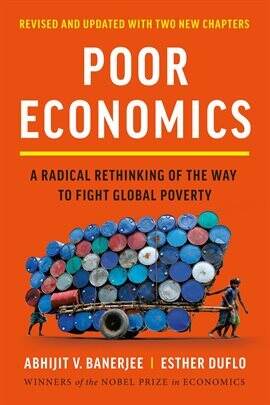
The winners of the Nobel Prize in Economics upend the most common assumptions about how economics works in this gripping and disruptive portrait of how poor people actually live.
Why do the poor borrow to save? Why do they miss out on free life-saving immunizations, but pay for unnecessary drugs? In Poor Economics, Abhijit V. Banerjee and Esther Duflo, two award-winning MIT professors, answer these questions based on years of field research from around the world. Called "marvelous, rewarding" by the Wall Street Journal, the book offers a radical rethinking of the economics of poverty and an intimate view of life on 99 cents a day. Poor Economics shows that creating a world without poverty begins with understanding the daily decisions facing the poor. Abhijit V. Banerjee is the Ford Foundation International Professor of Economics at the Massachusetts Institute of Technology. He lives in Cambridge, Massachusetts.
Esther Duflo is the Abdul Latif Jameel Professor of Poverty Alleviation and Development Economics in the Department of Economics at the Massachusetts Institute of Technology. She lives in Cambridge, Massachusetts.
Together, they are the winners of the 2019 Nobel Prize in Economics and coauthors of Good Economics for Hard Times. They have contributed to outlets as varied as Nature, NPR's Planet Money, the New York Times, and Econometrica, among others, and are frequent contributors to the French and Indian press. By the winners of the 2019 Nobel Prize in Economics Winner of the Financial Times/Goldman Sachs Best Business Book of the Year "Randomized trials are the hottest thing in the fight against poverty, and two excellent new books have just come out by leaders in the field. One is Poor Economics by Abhijit Banerjee and Esther Duflo. These terrific books move the debate to the crucial question: What kind of aid works best?"-New York Times "Marvelous, rewarding... the sheer detail and warm sympathy on display reflects a true appreciation of the challenges their subjects face. They have fought to establish a beachhead of honesty and rigor about evidence, evaluation and complexity in an aid world that would prefer to stick to glossy brochures and celebrity photo‑ops. For this they deserve to be congratulated‑‑and to be read."-Wall Street Journal "The ingenuity of these experiments aside, it is the rich and humane portrayal of the lives of the very poor that most impresses. [The authors] show how those in poverty make sophisticated calculations in the grimmest of circumstances. . . . Books such as these offer a better path forward. They are surely an experiment worth pursuing."-Financial Times "To cut to the chase: this is the best book about the lives of the poor that I have read for a very, very long time. The research is wide ranging. Much of it is new. Above all, Banerjee and Duflo take the poorest billion people as they find them. There is no wishful thinking. The attitude is straightforward and honest, occasionally painfully so. And some of the conclusions are surprising, even disconcerting."-Economist "A compelling and important read... An honest and readable account about the poor that stands a chance of actually yielding results."-Forbes.com "Duflo and Banerjee tell these stories (of their randomised control trials) in a lovely new book called Poor Economics. As they admit, randomistas cannot answer some big questions‑‑how to tackle food prices, for instance. But through lots of microstudies, they make a subtle case for one big argument: aid really can help poor people, provided the money follows the evidence."-Guardian "In an engrossing new book [the authors] draw on some intrepid research and a store of personal anecdotes to illuminate the lives of the 865m people who, at the last count, live on less than $0.99 a day."-Free Exchange (Economist) "Fascinating and captivating. Their work reads like a version of Freakonomics for the poor.