Books, videos, and music - all free from your public library!
LoginSign Up

Footer

Hoopla logo, Go to homepage
  • For Patrons
  • For Libraries (opens in new window)
  • For Vendors (opens in new window)
  • Facebook (opens in new window)
  • X (opens in new window)
  • Instagram (opens in new window)
  • YouTube (opens in new window)
  • TikTok (opens in new window)
  • LinkedIn (opens in new window)

Our Company

  • Our Story
  • Get Hoopla for your Library (opens in new window)
  • Get your content on hoopla (opens in new window)
  • Join our team (opens in new window)
  • Accessibility Statement

Our Content

  • Audiobooks
  • Ebooks
  • Movies
  • Television
  • Comics
  • BingePasses
  • Music
  • The Loop Blog

Help

  • Help Center
  • Submit Feedback
  • Facebook (opens in new window)
  • X (opens in new window)
  • Instagram (opens in new window)
  • YouTube (opens in new window)
  • TikTok (opens in new window)
  • LinkedIn (opens in new window)
  • Download on the App Store (opens in new window)
  • Get it on Google Play (opens in new window)
  • Available at Amazon Appstore (opens in new window)
© 2026 Midwest Tape, LLC. All rights reserved. Privacy Policy | Terms of Use
  • Hoopla logo
  • Browse
  • My Hoopla
  • Log In
  1. Navigate Home
  2. Ebooks
  3. Orphans Of Versailles

EBOOK

Orphans Of Versailles

The Germans in Western Poland, 1918-1939

Richard Blanke
(0)
sign up
Pages
328
Year
2021
Language
English
Publisher
The University Press of Kentucky

About

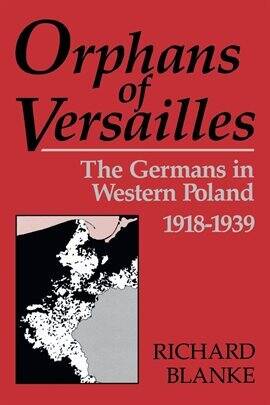
The lands Germany ceded to Poland after World War I included more than one million ethnic Germans for whom the change meant a sharp reversal of roles. The Polish government now confronted a German minority in a region where power relationships had been the other way around for more than a century.
Orphans of Versailles examines the complex psychological and political situation of Germans consigned to Poland, their treatment by the Polish government and society, their diverse strategies for survival, their place in international relations, and the impact of National Socialism.
Not a one-sided study of victimization, this book treats the contributions of both the Polish state and the German minority to the conflict that culminated in their mutual destruction. Based largely on research in European archives, it sheds new light on a key aspect of German-Polish relations, one that was long, overshadowed by concern over the German revanchist threat and the hostility that subsequently dominated the German-Polish relationship. Thanks to the new political situation in central Europe, however, this topic can finally be, addressed evenhandedly.
Related Subjects

  • General (Europe)
  • Europe
  • History
  • Adult Nonfiction
  • Eastern
  • General (20th Century)
  • 20th Century
  • Modern

Artists

Richard BlankeAuthor