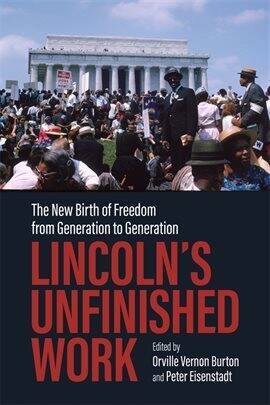
In his Gettysburg Address, Abraham Lincoln promised that the nation's sacrifices during the Civil War would lead to a "new birth of freedom." Lincoln's Unfinished Work analyzes how the United States has attempted to realize- or subvert-that promise over the past century and a half. The volume is not solely about Lincoln, or the immediate unfinished work of Reconstruction, or the broader unfinished work of America coming to terms with its tangled history of race, it investigates all three topics.
The book opens with an essay by Richard Carwardine, who explores Lincoln's distinctive sense of humor. Later in the volume, Stephen Kantrowitz examines the limitations of Lincoln's Native American policy, while James W. Loewen discusses how textbooks regularly downplay the sixteenth president's antislavery convictions. Lawrence T. McDonnell looks at the role of poor Blacks and whites in the disintegration of the Confederacy. Eric Foner provides an overview of the Constitution-shattering impact of the Civil War amendments. Essays by J. William Harris and Jerald Podair examine the fate of Lincoln's ideas about land distribution to freed people. Gregory P. Downs focuses on the structural limitations that Republicans faced in their efforts to control racist violence during Reconstruction. Adrienne Petty and Mark Schultz argue that Black land ownership in the post-Reconstruction South persisted at surprisingly high rates. Rhondda Robinson Thomas examines the role of convict labor in the construction of Clemson University, the site of the conference from which this book evolved. Other essays look at events in the twentieth and twenty-first centuries. Randall J. Stephens analyzes the political conservatism of white evangelical Christianity. Peter Eisenstadt uses the career of Jackie Robinson to explore the meanings of integration. Joshua Casmir Catalano and Briana Pocratsky examine the debased state of public history on the airwaves, particularly as purveyed by the History Channel. Gavin Wright rounds out the volume with a striking political and economic analysis of the collapse of the Democratic Party in the South.
Taken together, the essays in this volume offer a far-reaching, thought-provoking exploration of the unfinished work of democracy, particularly as it pertains to the legacy of slavery and white supremacy in America.
". . . seamlessly covering two centuries of American history, Lincoln's Unfinished Work: The New Birth of Freedom from Generation to Generation offers a possible starting point to completing the elusive project of equality for all Americans. . . . [it] is at once aspirational and clear-eyed about the challenges of interpreting history and effecting real change in our own times. It represents also
Journal of Southern History
"This book, a strong collection of essays distilled from a 2018 conference at Clemson University, is the fruit of the editors' attempt to render Abraham Lincoln a usable historical figure for antiracist activism in the troubled present. Defining his unfinished work as the continuing struggle for 'democratic inclusion' and, most especially, that 'of overcoming the legacy of slavery and white suprem