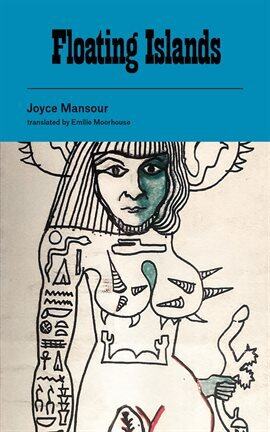
Three works that bookend Joyce Mansour's two decades of published fiction
"Floating Islands" is Joyce Mansour's most personal and unsettling work of prose. Set almost entirely within a hospital in Geneva, this work chronicles the slow collapse of boundaries between visitor and patient, authority and submission, imagination and extinction. What begins as an act of filial duty becomes an existential entrapment, as the narrator is absorbed into the institution's rhythms and hierarchies.
Doctors and nurses embody a cruel vitality, their health weaponized against the dying. Patients drift through states of dependency, hallucination, and rage. Bodies leak, fail, and betray their owners, while language splinters under the pressure of describing what polite discourse refuses to name. The hospital is a place for arrivals and departures, and it is where Mansour stages her own farewell: "Floating Islands," her final work of narrative prose, marks an important shift in her creative life in which she begins to look outward, rather than inward, for inspiration.
Rooted in Surrealism yet strikingly contemporary, "Floating Islands" (1973) is collected here alongside Mansour's earliest prose works, "Julius Caesar" (1955) and "The Parrot" (1956), a combination that reads as both culmination and reckoning: a final confrontation with mortality, authorship, and the limits of imagination.
Joyce Mansour (1928–1986) was born in England to a Jewish family of Syrian descent who moved to Egypt shortly after her birth, where she grew up among the English-speaking elite. After marrying a Francophone Egyptian, she learned to write in French and was forced into exile in Paris following the rise of Nasser. She authored sixteen books of poetry, as well as prose works and plays that confront desire, death, violence, and the female body with startling directness.
Emilie Moorhouse is a multidisciplinary writer, translator, and lecturer based in Montréal, Canada. Her previous translations include Emerald Wounds: Selected Poems of Joyce Mansour (City Lights Books, 2023), which was longlisted for the 2024 Griffin Poetry Prize. She holds an MFA from the University of British Columbia.
Praise for Floating Islands
"Floating Islands, both weirder and worthier, is a collection of fiction by the postwar Surrealist poet Joyce Mansour and quite literally a book of nightmares (I had one after my first read-ing): a decapitated head 'bleeding meaty bubbles'; the 'gelatinous hand' of a floating corpse. Translator Emilie Moorhouse renders Mansour's grotesquerie indelible, along with her unexpected shots of beauty: 'a swollen soul swung on the end of its stem'; children growing up 'in the sun-shine, full of sap and grand plans.'"-Dafna Izenberg, The Walrus
"The new release of a fresh translation of works by the unique literary icon Joyce Mansour is cause for celebration of various kinds, and Moorhouse's evocation of Mansour's singular voice into English is thus a gift that keeps on giving."-Donald Brackett
Praise for Emilie Moorhouse's translation of Emerald Wounds: Selected Poems by Joyce Mansour
"I'm so grateful to Moorhouse for her helping bring this remarkable poet's work to English readers, and help expand our knowledge of women writers throughout the world–helping buck against the historical chauvinism Mansour endured. I know my bookshelf will be better for it."-Diana Arterian, LitHub's The Annotated Nightstand
"Emilie Moorhouse's sharp, steamy translation of Syrian-Jewish poet Joyce Mansour … Surreal incarnations of raw female power–erotic, rageful–permeate."-Rebecca Morgan Frank, LitHub
"This is a very welcome translation, one English readers can trust. Mansour should be far more read (in both French and English) than she is. Emilie Moorhouse has performed an invaluable service to her and to French literature in English."-Christopher Sawyer-Lauçanno, Cable St