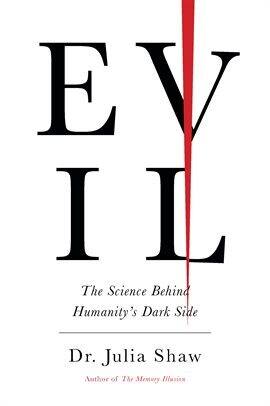
An original and scientifically rigorous exploration of the darkest recesses of the human mind.
What is it about evil that we find so compelling? From our obsession with serial killers to violence in pop culture, we seem inescapably drawn to the stories of monstrous acts and the aberrant people who commit them.
But evil, Dr. Julia Shaw argues, is all relative, rooted in our unique cultures. What one may consider normal, like sex before marriage, eating meat or being a banker, others may find abhorrent. And if evil is only in the eye of the beholder, can it be said to exist at all?
In Evil, Dr. Shaw uses case studies from academia, examples from popular culture and anecdotes from everyday life to break down complex information and concepts such as the neuroscience of evil, the psychology of bloodlust and workplace misbehaviour. In grappling with thorny dilemmas-from "Would I kill baby Hitler?" to "Why do I want to murder my spouse?"-Dr. Shaw offers readers a better understanding of the world, ourselves and our Google search histories. National Bestseller
"Curious readers will be riveted by Shaw's deliberate, rational discussions of such taboos as cyberbullying, homicide, pedophilia and the ways money and power corrupt the souls of formerly good men and women... A consistently fascinating journey into the darker sides of the human condition that will push on the boundaries of readers' comfort zones." -Kirkus Reviews
"Shaw presents a stimulating and provocative challenge to the traditional meaning of evil." -Library Journal
"Evil covers a wide range of subjects, from the creepiness of clowns and collectors to sexual deviance to the dark side of tech. Shaw undermines long-held beliefs about the universality of moral judgments for certain acts with more recent research, such as the supposed connection between testosterone and aggression. Her primary theme is that the concepts of violence and evil are much more complex than we realize, and before we judge we must always consider the context... Provocative." -Psychology Today
"Julia Shaw has crafted a brilliant panorama that elucidates humanity's dark side in her masterpiece, Evil. This science-based foundation for studying the minds of sadists, mass murderers, freaks and creeps, as well the new role of tech in promoting evil is presented in a totally engaging fashion." -Philip Zimbardo, author of The Lucifer Effect DR. JULIA SHAW is a senior lecturer in criminology and psychology at University College London. Born in Germany and raised in Canada, she has an MS in psychology and law and a PhD in psychology from the University of British Columbia. She is a regular contributor to Scientific American. INTRODUCTION:
THE HUNGER
The German philosopher Friedrich Nietzsche wrote in 1881: 'Böse denken heißt böse machen' — thinking evil means making evil. Only when we assign something the label 'evil', only when we think that something is evil, does it become so. Nietzsche argued that evil is a subjective experience, not something that is inherent to a person, or object, or action.
This book explores some of the science behind this sentiment, ranging across a spectrum of concepts and notions that are often associated with the word evil. It is a study of human hypocrisy, the absurdity of evil, ordinary madness and empathy. I hope to challenge you to rethink and reshape what it means to be bad.
Over the past thirteen years, as a student, lecturer and researcher, I have enjoyed discussing the science of evil with anyone who is willing to listen. What I like most is destroying the fundamental conceptualisations of good and evil as black and white, replacing them with nuance and scientific insight. I want us all to have a more informed way of discussing behaviour that at first we feel we cannot, and should not, begin to understand. Without understanding, we risk dehumanisingothers, writing off human beings simply becausewe don't