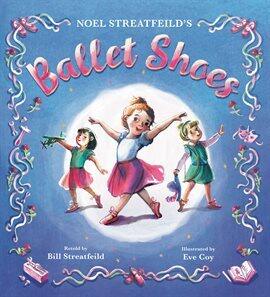
Three orphan girls. A pair of pink slippers. A lifetime in the spotlight. Read the classic that has captivated generations!
A PARADE BEST KIDS BOOK OF ALL TIME
Pauline, Petrova, and Posy love their quiet life together. They are orphans who have been raised as sisters, and when their new family needs money, the girls want to help. They decide to join the Children's Academy of Dancing and Stage Training to earn their keep. Each girl works hard following her dream. Pauline is destined for the movies. Posy is a born dancer. And Petrova? She finds she'd rather be a pilot than perform a pirouette.
This beautiful children's classic is perfect for girls who love to dream about ballet, friendship, and finding their own special talents. Adult readers may remember them as the "Shoes" books from You've Got Mail! Noel Streatfeild was born in Sussex in 1895 and was one of three sisters. Although she was considered the plain one she ended up leading the most glamorous and exciting life! After working in munitions factories and canteens for the armed forces when WWI broke out, Noel followed her dream of being on stage and went to the Royal Academy of Dramatic Arts, where she became a professional actress. She began writing children's books in 1931 and Ballet Shoes was published in 1936. She quickly became one of the most popular authors of her day. When she visited Puffin exhibitions, there were queues right out of the building and all the way down the Mall. She was one of the first winners of the Carnegie Medal and was awarded an OBE in 1983. Noel Streatfeild lived in London. She died in 1986.
The Fossil sisters lived in the Cromwell Road. At that end of it which is farthest away from the Brompton Road, and yet sufficiently near it so one could be taken to look at the dolls' houses in the Victoria and Albert every wet day. If the weather were not too wet, one was expected to "save the penny and walk."
Saving the penny and walking was a great feature of their lives.
"Gum," Pauline, the oldest, would say, "must have been a very taxi person; he couldn't have ever thought about walking or he'd never have bought a house at the far end of the longest road in London."
"I expect," Petrova, the second, would argue, "he had a motorcar all his own, and he never hired anything."
G.U.M. was the quick way of saying Great-Uncle Matthew. He was a legendary figure to the children, as he had gone on a voyage, and not come back, before any of them were old enough to remember him clearly. He had, however, been of the utmost importance in their lives.
"He's been," Pauline once said, "like the stork in the fairy tale. He very nearly did bring us in his beak." Storks in the Fossil children's nursery were always called Gums after that.
Gum had been a very important person. He had collected some of the finest fossils in the world, and though to many people fossils may not seem to be very interesting things to collect, there are others who find them as absorbing as sensible collections, such as stamps. Collecting fossils, he naturally needed somewhere to put them, and that is how he came to buy the house in the Cromwell Road. It had large rooms, and about six floors, including the basement, and on every floor, and in almost every room, he kept fossils. Naturally a house like that needed somebody to look after it, and he found just the right person. Gum had one nephew, who had died leaving a widow and a little girl. What was more suitable than to invite the widow and her child Sylvia, and Nana her nurse, to live in the house and take care of it for him? Ten years later the widowed niece died, but by then his great-niece Sylvia was sixteen, so she, helped by Nana, took her mother's place, and saw that the house and the fossils were all right.
Sometimes when the house got too full Nana would say:
"Now, Miss Sylvia dear, you must tell your uncle