AN INTERNATIONAL BESTSELLER
From the author of the international bestseller Beyond the Wall, a history of interwar Germany told through the town of Weimar, the cultural capital that was both the birthplace of the country's first full democracy and a launchpad for the Nazis.
"Katja Hoyer is a humane and compassionate writer, and her gripping book is poignant reading in our present circumstances." -Benjamin Carter Hett, author of The Death of Democracy
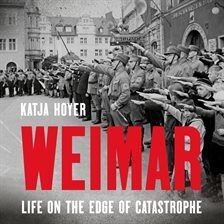
The Central German town of Weimar is perhaps most familiar to non-Germans for giving its name to the Weimar Republic. After Germany's inglorious defeat in World War I, the signing of a new constitution in Weimar marked the nation's first experiment with full-fledged democracy. And yet this storied town, long known as a center of German culture and tradition, was also the place where Nazis were first welcomed into a local government, a milestone in Adolf Hitler's fateful rise to power.
In Weimar, historian Katja Hoyer examines Weimar as a microcosm for the entire German nation between the world wars. The Weimar Republic saw a flourishing in culture and the arts, including the establishment in Weimar of the Bauhaus school of architecture. But after Hitler seized the chancellorship in 1933, the town underwent rapid Nazification, with many ordinary Weimarers basking in the attention they and their town received from the regime and from Hitler personally.
Combining gripping narrative with deep historical analysis, Weimar explores both the political upheavals and the rhythms of daily life in one town, revealing how fascism took hold first there, and then across the nation. Katja Hoyer is a German British historian, journalist, and the author of the widely acclaimed Beyond the Wall and Blood and Iron. A visiting research fellow at King's College London and a fellow of the Royal Historical Society, she is a columnist for the Berliner Zeitung, and her writing on German current affairs has appeared in Bloomberg, The Guardian, The Spectator, and elsewhere. She was born in Germany and is now based in the UK. "Weimar is populated not by abstractions but by people. ... Hoyer writes with verve and a keen eye for the telling detail. ... She shows with quiet acuity how ordinary, self-respecting Weimarers succumbed to the siren call of Nazism."-The Times (UK) "Britain's favourite German historian... Hoyer has been beavering away in the archives to tell the story of the crack-up of democracy in interwar Germany, through a vivid cast of characters."-Sunday Times "A bright, young historian... Strap in to watch the slow collapse of a society, amid a throng of fascists, socialists, artists and politicians."-The Telegraph "Its writing is gripping, Hoyer's command of existent histories is clear, and her primary research is thorough and inventive."-History Today "The city of Weimar - home to many of the giants of European culture - gave its name to Germany's ill-fated republic; it was also where the Nazis gained an early foothold. Historian Hoyer charts that journey of cultural experimentation and political upheaval through the stories of those who witnessed it and whose choices and fates reveal the human experience of a descent into tyranny."-Financial Times "Lucid, lively. … Entirely to her credit, Hoyer describes the vices, vanities, fears, cowardice, heroism, naivety, cynicism, opportunism and the very human instinct to protect one's loved ones without indulging in self-righteous moralising."-New Statesman "Hoyer's book confronts us with troubling ambiguities … Understanding why ordinary, even likeable, people turned away from democracy is, she argues, essential to safeguarding freedom … that task could scarcely be more urgent."-Guardian "Such an important book."-The Independent, Book of the Month "A nuanced account of the spiritual and cultural heart of Germany … Hoyer serves up hist