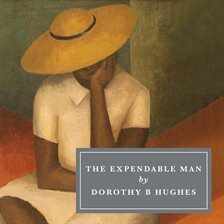
Trainee doctor Hugh Densmore is on his way to a wedding in Phoenix. Just two days later, he is a suspect in a murder investigation. Set under a sweltering Arizona sun, The Expendable Man shows up the racial, social and moral tensions rife in 1960s America.
Hugh Densmore picks up a young hitchhiker on a deserted stretch of road. Though he initially takes pity on her, something doesn't add up: her backstory is barely believable. Despite this, 'Iris' cunningly gets Hugh to take her all the way to Phoenix, then shows up at his motel the same evening hinting that she needs an abortion. Already unnerved, panic seizes Hugh when two officers show up to question him following reports of a girl's body in a canal. Then comes a revelation which upends the entire novel. And as the police's net closes in, Hugh rushes to find the real culprit and evade a scandal which threatens to engulf him.
The Expendable Man is part of the Persephone Audiobook Collection, a series of forgotten classics including neglected fiction and non-fiction by women writers. First published in 1963, this edition includes an afterword by Dominic Power. Dorothy Belle Flanagan was born in 1904 and grew up in Kansas City. Following a bachelor's degree in journalism, she found work in the same field. She married Levi Allen Hughes Jr. in 1932. The So Blue Marble, her first thriller, was published in 1940 to much acclaim. Thirteen more would follow, including The Fallen Sparrow (1942), Ride the Pink Horse (1946) and In a Lonely Place (1947), which also became classic noir films. She settled in Santa Fe, New Mexico, and The Expendable Man (1963) was her last novel. Dorothy B. Hughes won the Edgar Award in 1950 and was named a Grand Master by the Mystery Writers of America in 1978. Hughes died in Oregon in 1993. A young doctor in training must prove his innocence in a murder inquiry.